(Invited post by NP-complete)
 1.- The discovery of the machine
My first gut feeling was that that chap in the hardware store was teasing me. In my fifteen years as an electronic engineer I had never seen such stuff. That product simply couldn’t be real. But ok, for just one euro, I could well afford the risk.
When I reached home I couldn’t stop thinking of all the things I could have bought with that euro. An electronic device that splits the universe into different universes? Well, that’s what the manufacturer’s instructions claimed. “Fork Industries Ltd.” I had never heard about a manufacturer by that name. The device was a simple black panel with a few buttons and a numeric display. If I got swindled, at least I could take it apart and reuse the components to recover my investment.
There was a “reset” button, to start the system, and a “bifurcate universe” button, according to the instructions. A presumptuous name for a button, right? According to those instructions, when pressing that button, the universe would split into two almost identical parallel universes, no less than that! The only difference between the two universes would be that, in one of them, the panel display would show a 0, and in the other universe it would show a 1. In both universes, all the rest would be exactly the same, no more differences. I thought that, even assuming that the machine was not a scam and that it really did that thing, the difference was really stupid. What use is that, a 0 in one universe and a 1 in another?
The text explained also that you could do consecutive bifurcations. If the user pressed that button a single time, then two universes would be created: the one showing a 0 in the panel display and the one showing a 1. But if you pressed twice, then four universes would be created: in one of them you would see first a 0, and then another 0; there would be another one where you would see a 0 and then a 1; another with 1 and 0, and yet another with 1 and 1. If you pressed three times, then eight universes would open up: one with 000, another with 001, other one with 010… and so forth until you get all combinations, ending with 111.
I am sorry but, even assuming that that story of the bifurcated universes were true, it would still be useless to do all such bifurcations: what’s the point in being in a universe where the machine has showed, after five consecutive bifurcations, 00101 or 11101? If the rest of the universe is identical, if the only difference is made by a few little digits in a screen, what’s the big deal?
Then I saw that the instructions went beyond that. They explained that there was a way, a single way, to communicate all those universes among themselves. The numerical keyboard in the panel allowed users to type any number whatsoever. At its side, there was an enter button. If the user types a number in the keyboard and presses enter, then the machine will show in the panel the sequence of 0s and 1s of bifurcations performed in one of the bifurcated universes. Concretely, that sequence would correspond to the universe where the user had typed the highest value among all those submitted by the users in all the universes. For example, if after five bifurcations the user who types the highest number (e.g. 543) is the one living in the universe 10011, then, when users write their respective numbers (all smaller than 543), they will see the sequence 10011 appear in their panel displays of their respective machines.
When such a communication is performed (or when you press reset), the possibility of further communication among the previously bifurcated universes is cancelled forever. From that time on, you will only be allowed to communicate in such a way with the new universes you bifurcate with the machine in the future.
And that’s all. The machine didn’t allow anything else.
What a scam.
But, ok, there was only one way to be sure. I decided to try. I would press the button eight times, and that way I should be creating 256 parallel universes (with eight 0s or 1s there are 256 possible combinations). And my parents always said I would never reach anywhere! They would see me multiplying by 256 the divine creation! I decided that, after I was happily done with my bifurcations, I would convert to decimal the sequence of eight 0s and 1s which had appeared in my machine’s display, and then I would type such a number in the keyboard.
And that’s what I did. After pressing eight times the button, that is, after bifurcating the universe eight times, the sequence of values I observed was 00100101. That is, number 37 in decimal basis. Then I wrote 37 in the panel keyboard and pressed enter. Immediately, the sequence 11111111 appeared in the panel.
It made sense, of course. Out of the 256 universes which I had created, the universe that had witnessed the highest number must have been 11111111, which is 255 in decimal. So 255 had beaten all the others (including, of course, the 37 of my own universe). Thus, all the “myselves” of the 256 universes I had created would be watching at that very moment the very same sequence of values which gave rise to the winning universe: 11111111.
Wonderful, but that didn’t prove anything. That bifurcation story could be a lie. The machine might be programmed to show only the highest possible number.
Then I fancied a better experiment. Now I would press the bifurcation button eight times, but this time I would type the number of values which change from 0 to 1, or 1 to 0, when reading the sequence left to right. For example, if I saw 111111111, then I would type 0, since there is no change in the sequence. If I saw 11100110, I would type 3, because there is one change between the third and fourth symbol (1 to 0), another between the fifth and sixth symbols (0 to 1) and another between the seventh and eighth (1 to 0).
I pressed eight times and I got 10101111. Four changes. I wrote 4 and pressed enter.
Then the machine showed 10101010.
Dammit! There were 7 changes! And that amount of changes was unbeatable, there was no way to get more changes with eight values. It’s tied with 01010101, but there is no other sequence which can win. In the 256 universes that I had opened up, it was really the maximal amount of changes that one could get.
But I had not said anyone that this time I would type the number of changes instead of the decimal number of the sequence, as I did previously. The machine didn’t know that! Only I knew it!
Dammit! The machine worked! It worked!
Immediately I started to think about how to take profit of such a prodigious device.
I might press the button a number of times large enough so that the resulting sequence of 0s and 1s could represent a lottery combination (I may transform the 0s and 1s into a sequence of decimal numbers, and those would be the number on which I would bet). I would bet on the numbers displayed by the machine, and wait for the lottery outcome. Then I would type in the panel keyboard the number of millions of euros I had won with that combination. In most of those universes that number would just be zero, of course. Nonetheless, in one of those universes I would be a millionaire since, having created a universe for each possible combination, there must be one of them in which I had found the winning combination. In that winning universe, I would type in the machine the high number of gained millions. Then, all myselves from all the universes would receive the sequence of 0s and 1s which was used in that winning universe. This way we would find the winning combination, and use it to win the lottery.
Just a second… If I did that way, I would only know the winning combination after the lottery outcome was made public, which is when the winner would communicate it from his parallel universe. No, that would not do. By doing that I would only ensure that one of the myselves would be rich, but not the rest of us. That is useless for me. The probabilities that I would become rich are exactly the same as if I played in the traditional way, without using the machine. So, practically zero.
There must be a way to take profit of this machine…
Then I figured it out. I might use the machine to break all kinds of codes. If I pressed the bifurcation button a sufficiently high number of times, so that I would get enough 0s and 1s to codify a word of many letters (in fact, for every eight 0 or 1 I get a computer character, which can be a letter or other things), then I might find any password with the resulting letters. If every possible password which one can use in a computer appears in one of the displayed universes, then in one of the universes I would have the right password.
I connected to my computer and entered the mail server of my ex. I wrote her login. Then I pressed the bifurcation button 160 times, enough for the 0s and 1s to codify a word of 20 letters (more precisely, characters). In each of the many universes which I had just deployed, the result of converting all those 160 0s and 1s into a single word would be different. Moreover, each possible 20-letter word appears in one of the possible universes. So, if in all the universes I typed the resulting word, in one of them I would succeed and I would enter the email account of my ex. I decided that, in the universe in which I succeeded, I would type 1 into the machine keyboard and press enter, and in all others I would type 0 and press enter.
The word which was brought about by the 160 0s and 1s in my own universe was not the right password, as one might guess. So, I typed 0 in the machine, and immediately the display showed another sequence of 160 values. That sequence should come from the universe in which another version of myself had typed the biggest number into the machine keyboard, following the rules I had forced myself to follow: 1, which meant correct answer. I converted that other sequence into a word, tried again to enter the account with this new password and bingo! I was inside!
Beyond the sick interest I had in the account, obviously I thought of the more lucrative possibilities which opened up in front of me: I might enter bank accounts all over the world and order money transfers to my own account. Or, better, to some others, so that nobody could catch me. In different countries. With different names.
So my economic future was solved thanks to the little machine. Not bad for an euro!
A nice future opened up in front of me.

2.- The creative explosion
For the following years, I enjoyed all kinds of luxuries from my unlimited economic capacity.
Nonetheless, after thousands of travels, luxuries and rave-ups, a moment came when I felt empty.
Then I decided I wanted to develop my artistic vein. I dismounted the bifurcation button, opening the case, and observed that every press of the button released a five volt signal in a machine cable. So that’s how the machine perceived each bifurcation button press.
I connected that cable to my computer, and prepared by computer so that it would send 5 volt impulses whenever the computer wanted. Since my computer might send those impulses at the same speed as any other data plug (such as, e.g., the USB port), from that time on my computer would be able to “press” the machine’s bifurcation button at a speed much higher than my finger could never reach with real pressing.
Then, I dismounted the machine display and realized that the leds which made up the numbers (where the machine wrote 0 or 1), received also 5 volt impulses from the machine through certain cables.
I connected those cables to my computer, in such a way that the impulses that the machine sent to lighten the display would be immediately detected by my computer. From that time on, my computer would create the button keystrokes of that wonderful machine, and would read the sequences of 0s and 1s that it would output.
Then I programmed my computer to send eighty thousand million signals to the bifurcation button of the machine. It took barely a few minutes.
Oh my god, now I had created a huge number of parallel universes! Actually, many more than eighty thousand million, since each keystroke multiplied the number of universes by two… Do the math, and you’ll see that the number of parallel universes I had just created had more than twenty thousand million digits. Crazy!
My computer had captured the sequence of eighty thousand million 0s and 1s with which the machine had answered to those keystrokes, and stored it in a file in my hard drive… which took slightly less than ten gigabytes (that’s less impressive, isn’t it?)
Then I put an “.avi” extension to the resulting file and tried to open it in the video player of my operating system.
“The file is corrupt”, my computer replied.
That’s only logical, since most random sequences of 0s and 1s do not form a valid video file.
But a tiny fraction of those sequences do form a valid video file.
And a very tiny fraction of those make up a video that does not consist of mere snow.
And an even tinier fraction of those make up images that might correspond to a movie.
And an even tinier fraction of those make up an excellent movie.
I had decided that, in case the resulting video made absolutely any sense, I would take the file thus generated and submit it to various film studios in order to try to get the movie in the theaters.
Since my file did not even open, that was not my case, clearly.
I waited a few months. Then, the day after the Oscar ceremony of that year, I typed a 0 into the machine keyboard. My plan was that it would mean that my (no-)movie had won 0 Oscars. Obvious, it had not even entered the competition.
Then my computer started to register the sequence of 0s and 1s that had been produced in the universe in which the value introduced by my other I was the highest. Taking into account that, among all the displayed universes, all myselves would have viewed all the movies that can be stored in a 10 gigabyte file (btw, enough to obtain a high image and sound quality), the thing was promising.
The complete sequence received from that universe was finally stored in my computer. I added the “.avi” extension to the file and tried to open it with my video player.
This time, it opened.
How I laughed. How I cried. How it made me think. I still get shivers when I remember some scenes. Moreover, I still get shivers when I remember many scenes. What the heck, I still get shivers when I remember any single snapshot of the movie! It was simply perfect!
I had my movie premiered.
A few months after that, in the next Oscar ceremony, my movie won in all categories. All 24!
For it to win in all existing categories, you may have guessed that it was not in English (impossible winning also the foreign language category otherwise). Also, it was an animated feature, but also included real actors… which, by the way, made memorable performances. With those costumes, that makeup, those visual effects… wonderful!
A few months before, when I first showed the movie around, I inscribed myself as responsible for all technical categories. But I needed other people to play as actors. I did not look like any of the movie characters at all, so I needed different people to help me. You cannot get the Oscar if there is nobody real behind, whom do you give it to? Simply, I could not have won those Oscars without real people which could be assigned the roles for the performances. But that posed no real problem. The fact that I had won all the Oscars in other universe guaranteed that, in fact, I would manage to find people which did really look like the movie characters. Those people happened to be my cousin, my sister-in-law, my mother, etc., none of them had ever acted before. All of them received, very proudly, their Oscars.
It occurred to me that I might repeat the feat on the next year, just trying to maximize the number of Oscars won by myself, personally, not by the movie. But I discarded the idea. It was complicated to win, at the same time, the Oscar to best leading actor and best supporting actor. No matter how many times I appeared in the movie, I would only be considered leading actor. And, foremost, the Oscars to best leading and supporting actress seemed hopelessly difficult to me.
I decided that I should move and explore new fields. Using the same technique, in the following years I “wrote” the best-selling novels, I “programmed” the best video-games, I “recorded” the best songs, and made the most important scientific discoveries. I won all the research prizes that could be achieved with a merely theoretical setup (since my works were, really, computer files: books, articles, essays, plots, videos, etc.) For example, I solved a tough problem in mathematics which, apparently, had remained unsolved for long (consisting in comparing two thing called “P” and “NP”). Really I didn’t understand a single word of the result, despite I had proved it myself, but what others said in the following years made me think that, perhaps, that result bore some relation to how my wonderful (and secret) bifurcating machine operated.
Once here, you may come to think that I always submitted to publishers, contests or symposia my art or scientific works twice: one with the file generated in my universe and the other with the file I received from the universe where I was most successful. In that case, you may think I would be known as the guy that submits stupid things the first time and wonders on the second. But that was not true. I can say that all the files I generated in my own universe never made any sense: only a couple of times those files opened correctly with the corresponding application, and both times all I got was noise. Take into account that the vast majority of the sequences of possible symbols simply do not mean anything. So it was very hard to obtain a file which was even remotely worth sending to anybody. But that was irrelevant, since all possible files were generated in one of the displayed universes, so in some of them the good one would lurk. For the rest of the world, I was not the guy sending stupid things on the first time and wonders on the second. I was simply, the guy that always created wonders.

3.- Obsolete instructions to be happy
Full of money and prizes, recognition and glory, the time came again when I felt empty.
Then I decided I would use my machine to be happy. In fact, the machine itself would tell me how to do it.
I used the same technique I had used the previous times to generate, with the bifurcation machine, a file of 0s and 1s, which this time I interpreted as a text file. I decided that this file would tell me what to do during the next year to be happy: throughout the year I would follow all the advices included in that file which made some sense (there is no way to follow fd%s$$gf#dfg0d78sfg) and were also reasonable. I would not jump out of a cliff, no matter how clear the text told me so, or smash the bifurcation machine with a hammer, although I decided I would follow some strange instructions, such as, for example, never saying hi, bathing every day in a tub filled with raw eggs, start all my sentences with the word krupuk or become a Methodist missionary. I decided that, when the year was over, I would type into the machine a number that would reflect the grade I gave that year in terms of happiness. Then I would receive in the machine the sequence of 0s and 1s corresponding to the advice text which had been followed by the myself which had typed the highest grade (that is, the one which had been happier by following those advices). During the next year, I would follow exactly those advices which had made my other self so happy. All of us would enjoy, with one year of delay, the same happiness our luckiest myself had received.
I took the steps. As it was likely, the instructions I received in my own universe did not make any sense. I found no single meaningful word of more than two letters in that absurd three pages sequence of symbols. So, in my universe, I had simply no instructions to follow.
By the end of the year, I received the instructions from the myself which had been the happiest in all the universes during that year, as I had foreseen. The text file instructed me to try to meet a certain lady, become her couple and live with her. It sounded good. In theory, those steps would take me to an optimal happiness, unsurpassed in any universe.
I reached the lady’s home. As it was expected, she immediately recognized me, because she was a fan of some of my works, as most of the world population was. So it was easy to start the conversation.
Nonetheless, after a few minutes I discovered she had started a relationship a couple of months before. The conversation ended cordially, but the situation was different from what I imagined.
I visited her again during the following days and weeks. I persevered, that should not stop me. I should achieve the happiness those instructions promised. I thought my immense popularity as the biggest creator in History would work its magic.
Inexplicably, it didn’t. Maybe I relied too much on that strategy based on my popularity, so she thought I was a cocky jerk that thought he would get anything he desired.
What had worked for one myself on the previous year, when maybe the lady was single, would not work for me, because everything had changed in a single year. The opportunities were different. It was like the wrong strategy to win the lottery I mentioned earlier: sometimes, the successful solution a posteriori is good for nothing.
In fact, all that year was a complete mess. Following the rest of the advices in those instructions, which were so helpful to my other self from another universe to enjoy a perfect life with that woman, were useless because it all depended on the first step, which implied the successful establishment of a relationship with that lady.
I thought for some time about that difficulty that blocked my use of the machine to get the perfect advice to happiness. The problem was that all the advices would reach delayed. If other self from another universe advised to do a certain thing, perhaps the possibility of profiting from certain action would be gone in one year, a day, or even a few minutes. The validity of the advices would always be ephemeral, and its utility uncertain.
I didn’t find a solution to that problem, so I decided to use an intelligence more powerful than mine to solve it. I used the machine to generate all possible texts in a single sheet, in search for one which might solve my problem. In each universe I would read the resulting text in that universe, and I would score it according to its potential utility to solve my problem. Thus, when in all universes we received the best scored text, we would have the best solution to the problem, if it existed.
When I read that best solution coming from one of those universes, I was quite intrigued. According to that text, the machine instructions never specified that the time in all displayed universes should advance simultaneously, so there was the chance that, in fact, each universe had its own time, whose existence was independent from all the others. Therefore, I didn’t have to assume that, in order to receive the sequence of 0s and 1s of the universe where the maximum value was entered, I had to wait in my own universe for the same amount of time that it took in that universe for the number to be entered. I should consider the possibility that, when typing a value and pressing enter in my own universe, I would receive immediately the sequence of 0s and 1s from the universe where the entered value was the highest, independently of how long it took for that value to be entered in that universe. Perhaps its universe had its own independent time, so waiting for one day, one month or one year in your own universe might have nothing to do with the same lapse of time passing by in other universe. The communication between universes through typed values in the machine might be independent from each particular universe’s time.
Well, that text was only one idea that another myself, from another universe, valued enormously for how much he felt intrigued by it, nothing else. This myself had no chance to test it before scoring it, because in order to do so he should have created his own universes in order to establish a new communication, which would have prevented him from communicating with me: every time you write a score, you break the possibility of getting in touch again with formerly deployed universes. That was explicitly said in the instructions indeed.
Nonetheless, that idea was truly intriguing. Nothing in the instructions was against that possibility.
I decided to check it out. I would perform the following experiment: I would press the bifurcation button once. If I got a 0, then I would type immediately the value 0 in the machine and press enter. On the other hand, if I got 1, then I would wait a minute and then I would press again. If this time I obtained a 0, then I would enter immediately the value 1 in the machine and press enter. But if I got 1 again, then I would wait another minute. Then I would press again and, if this time I obtained 0, I would type 2, otherwise I would wait another minute. I would follow the same procedure for a maximum of 9 times: if then I obtained a 0, I would type 9, and if that time I obtained again a 1, then I would wait for one more minute and then I would press 10 without bifurcating again. You may have realized that, in any case, I would type in the machine the number of minutes that I had would have to wait until obtaining a 0, up to a maximum value of 10.
I followed that strategy and had to wait, in my case, for six minutes. Just when I typed 6 and pressed enter, I received in the display the sequence 1111111111, that is, ten 1s.
If it had taken me six minutes for me to be able to observe a sequence which, in another universe, had taken ten minutes to obtain, then what that text said was true! Each universe had, really, its own time! Communication between the machines in all universes as time independent! My assumption that the time had to flow synchronously in all deployed universes was, simply, false. In fact, the instructions didn’t state it anywhere. My mistake was due to a bad assumption.
Very excited, I decided that I had to look for a way to profit from that novelty.
The first thing that occurred to me was that the lottery problem I mentioned some pages ago (the problem that I would receive the winning combination only after the lottery outcome was made public) might be solved. I would do the following: bifurcate the universe enough times in order to be able, with the resulting 0s and 1s, to fill up a lottery ticket. Then I would press the button one more time. If this time I got a 1, then I would buy the ticket, fill it up with my sequence of 0s and 1s converted into the corresponding bet, wait for the lottery and then type into the machine the number of millions that I had won. Otherwise, if the last number was a 0, then I wouldn’t play. Instead, I would type immediately the number of millions I won with my (no-)ticket, thus, 0, and I would press enter. In that last case, I would immediately know the combination that made other myself win the lottery in another universe. Since I would know that combination before the lottery draw, I could buy a ticket, fill it up as my combination said, and win the lottery.
This way I would get half of myselves (those who obtained 0 in the last pressing) win the lottery, but I would not be able to guarantee that the rest would (those obtaining a 1), which would have to play with a very low probability of winning (exactly the same as all the other morons playing legally). The myselves which had had to play normally would repeat the same operation on the following day lottery draw. Again, they would have 50% chance of not playing and knowing immediately the winning combination (before the draw), and 50% of having to play with the combination they had obtained and (very likely) not winning the lottery for now. Then, the myselves which would have had to play would repeat the same procedure one more day, and so on. The chances of a myself being forced to play at least twenty times (so, about three weeks) without getting no winning combination before his respective draw would be about one in a million. If we increased it up to forty times (a bit more than a month), then those probabilities would be of one in a million millions. In fact, what I expected was that I would have to play normally none or just once before knowing a winning combination beforehand (try and calculate it!). Certainly, the method was worth a try.
It took me more than I imagined to win the lottery: I made it at my fourth try. But it was a huge satisfaction. Don’t get me wrong, I didn’t really need that money. The robberies I had done a few years back, by trivially breaking the codes of bank accounts of thousands of people, had made me millionaire. I abandoned those robberies when I became the most creative person on Earth. After producing thousands of works and marvelous patents in all arts and sciences, my royalties came to provide me with more money than the GDP of a middle-sized European country. So, it was obvious that I didn’t need to win the lottery for the money. Nonetheless, doing it, when I had thought that I would never be able to do it, filled me with satisfaction.

4.- Towards optimal short-range happiness
My success in the lottery case made me understand that I could now solve my past problems when, not so long ago, I tried to use the machine simply to be happy (that failure with that girl).
Such attempt failed because I knew what would give my success after some delay, when the opportunities had already gone. Nonetheless, after my previous lottery experience I knew that I might use the same method in order to avoid that delay. Again, I would use the machine to generate all the texts of advices to myself in order to be happy for the next year, for example, three pages each. Then I would press the button once more. If I obtained 1 in that last pressing, and the instructions received were susceptible of being obeyed somehow (I decided that I would not try to follow instructions that didn’t contain at least a readable sequence of seven or more letters) then I would obey those instructions within reason, and by the end of the year I would type a value scoring that year in terms of happiness. On the other hand, if I obtained a 0 in that last pressing (or if I obtained a 1 but the instructions were not readable), then I would ignore the instructions and type 0 into the machine so that those ignored instructions could not win. After doing that, I would immediately receive the sequence of 0s and 1s with the instructions that were obeyed by my other self who obtained the maximum possible happiness during the next year (or should I say “will be obeyed” and “will obtain”?). Since I would receive them immediately, I might follow those instructions from the very moment when my other self obtained them, and I would get his same success.
Regarding all others who would get a 1 in their last press and had to follow their instructions, they might repeat the same process the next year, when they might obtain a 0 after receiving new instructions and might finally profit from the success found by other. The probability that he would have to wait for forty tries (forty years) would be much less than one in a million millions (which is the probability of finding forty 0s in a row), because most of the instructions cannot be obeyed and would halt the waiting even obtaining a 1. Besides, the expected wait would be, really, between zero and one year (in fact, much closer to zero than to one): zero had half the chances and, besides, I would also have to wait for zero years if I obtained a 1 but the text was simply unreadable (and most texts are).
And so I did. I obtained a text of instructions with my pressings, but I simply discarded it because, after them, the last pressing gave me a 0. Then I introduced the value 0 in the machine, and immediately I started to receive the sequence of 0s and 1s from the happiest myself during the next year.
Just as the other time, the instructions again explained that I should start a certain sentimental relationship. The difference was that this time I knew the instructions at the same time as the successful myself knew them, not one year later.
I followed his steps, and this time I found that the lady in question was not in a relationship. In fact, in a short time I became her partner. The relationship was, in fact, wonderful.
When the year was over and the instructions were finished, I decided I needed no more instructions. I was happy. I would continue living that life.
Nonetheless, three months later she left me for another guy. I was devastated, it was horrible. In fact, by seeing how I ended up, I decided that the happiness of the previous year did not pay up for that pain. I wished I had never met her.
I cannot blame the other myself for recommending me, with his high score of happiness, those instructions. When he scored his year, evidently he did it before that breakup took place to himself, when a single year had gone by. He knew nothing.
This time, my problem was to assume that short-term happiness and long-term happiness would coincide. But it was not true.

5.- Towards a life-long happiness
There should be some way to solve that problem too. A possibility was to repeat the same process, but with a forty year span, instead of only one year. After forty years, the old myselves would score their live-long happiness, and the other myselves which had stayed in the present would be able to know which were the best decisions for a life. Some would explore all paths to happiness so others would benefit.
Then I thought that aim was far too ambitious. Those having to live forty years obeying absurd instructions would get no reward for their loyalty to the others. Then I found an alternative way to take into account the long-term happiness and combine it with the short-term one.
To start with, I would renounce trying to get detailed instructions, telling me every moment how to proceed. Circumstantial instructions, with orders which are only valid for certain moments, are only useful if you follow them at the same time, with the same opportunities, which made them quite restrictive. On the contrary, I would try to find time-independent commands, attitudes towards life, such as “be bold”, “be greedy”, “be resentful”, “be attentive”, etc. and combinations thereof. With this new target, I would only follow time-independent orders and disregard any instructions which were dependent on the current situation. I would search for the best life attitude, the best general way to proceed, instead of running after which steps to follow every moment, which in fact would make me slave of my destiny, written and known beforehand.
Once those new objectives were fixed, I would act in the following way. I would press the bifurcation button to obtain, with the resulting 0s and 1s, about three pages instructions which would show me which should be my attitudes in life. Then I would press one more time. If I obtained a 1, then I would obey those instructions during the next year. By the end of the year, I would press again. If I obtained a 1 again, then I would obey those same instructions for one more year. The process would repeat until I obtained, some year, a 0. When that happened, I would type into the machine a value that scored my happiness during all those years following those instructions. However, that score would also take into account for how many years I had followed those instructions. I worked out a way to score my happiness in the machine so that, the more years the instructions had served me, the higher the score. Let us imagine that two instructions texts made me equally happy, but one of them worked for more years. Then the latter would get a higher score. A short period of happiness would only get a larger score than a longer one if I had been much happier in the first. In that case, I might assume that that happiness in a short period might compensate for any disgrace that might come afterwards (which, in principle, would not be more likely than through any other path).
Again, the chances that one myself had to wait for 40 years without typing his score and getting to know the instructions in the best-scored universe would be, at most, one in a million millions. The procedure was definitely worth.
I put my plan into practice. After the sequence of 0s and 1s for my own instructions, I pressed the bifurcation button once more. I obtained a 1. That meant that I would have to put those instructions in practice for, at least, one year, after which I would have a new opportunity of pressing the bifurcation button to check if I could, at last, know the instructions which would take towards happiness.
The following year, I pressed again, and again I got a 1. One more year.
And the following year, the same. Another 1. And the same on the next one, and the other, and the other. It started to surprise me the unusual number of years during which I had to follow the received instructions.
After ten years getting 1s, I started to realize that I was getting old while I was playing that weird game. I wondered if, when I finally got the instructions from my happiest myself, I would be young enough for those optimal instructions to have the same effect on me.
The 1s continued repeating year after year. That was not normal. Something strange was happening. I started to distrust.
The day I reached twenty years getting 1 after 1, I meditated very seriously about my situation. The likelihood of waiting twenty years for the coveted 0 was less than one in a million.
More years followed with 1s. Less likelihood even. My mistrust had become unbearable. Of course, since all sequences were explored, someone had to receive the twenty-five 1s in a row. Notwithstanding, the likelihood that it was me was so low that I started to consider the possibility that someone was swindling me. Maybe some of the other myselves had found a way for them not to get so many 1s, which, just by elimination, forced those unending sequences of 1s on the others. Moreover, maybe almost all others had discovered that mysterious trick and I was one of the few morons which the others were using to see what happened after many years following the same instructions and take profit.
Then I reached the thirty 1s in a row. Dammit, thirty years ago I had less than one chance in a thousand million to reach this point. Definitely, the probability that someone was playing a trick on me seemed much larger than that.
I could not forget that, many years ago, I had used the machine to tell me something I didn’t know about the machine itself. It was that time when I discovered that the time in each parallel universe runs independently. Maybe I might use the machine to find a feasible way in which the other myselves would be swindling me. I might press many times to explore all possible texts which might explain those tricks to me.
But then I thought that would not work. Let’s say that there is really a way to swindle the other myselves so that one gets benefit, for example by making the others spend years and years following stupid instructions, a 1 after the next, while the swindler would receive immediately the fruits of that massive exploration by getting a 0. In that case, if I used the machine to bifurcate more the universe and find that trick (by exploring all texts explaining that trick), then the new myself who would discover the trick might save the trick for himself, and benefit by using it against me. No, I couldn’t use the machine to discover the Machiavellian plan that was for sure acting on me. I could not rely.
More years went by, and I got more 1s. Every year I got angrier when I saw that damned number. Dammit! The likelihood that someone was swindling me so I got all those 1s had to be, for sure, much larger than the probability of getting thirty-seven 1s in a row. That made no sense.
Then that year my mistrust exploded. I said enough. I had to accept that I would never be able to know how they had played with me. Notwithstanding, I might strike back. I decided I would wait only one more year. If I didn’t get a 0 next time, I would take revenge.
Then, the next year, the 0 came. It came!
That day I wept of happiness.
In fact, that day was yesterday.
Nevertheless, my happiness has become misgivings and suffering since last night.
As a matter of fact, I have not slept the whole night. I have thought that, very likely, I finally got the 0 simply because the other motherfuckers estimated that thirty-eight years would be the maximal amount of time anyone would stand it while being fooled. And, moreover, exactly thirty-eight tries! Of course, they avoided the 0 appearing exactly on the fortieth attempt, too round a number. That’s why they have given my 0 at the thirty-eighth attempt. Moreover, making me spend all my life following instructions is only useful if I score them before I die. Only then the instructions will enter the bag of all those evaluated and compared, out of which the perfect instructions will come and from which they all will benefit. So, in no way they would have given me 1s forever. They needed a 0 to come when I was very old. They’ve exploited me as much as they could. Fucking bastards!
I am sorry, but it’s too late for those motherfuckers. I’m a fucking old man, they cannot give me my youth back. With certainty, if now I enter my score, the new instructions I will then get, coming from the happiest myself, will be useless for me, because I am far too old to do anything worth it. Fucking bastards. I must complete my revenge against all of them in any case. It’s not important that I finally got a 0. They’ve fucked my life with their damned trick.
Now I find myself decrepit and disgusted, in front of my machine, ready to complete my revenge.
I approach the machine and I introduce the value which, according to what we all agreed four decades ago (when it was just I), would represent the maximum possible score. In fact, we had (I had) agreed that that score would be, in fact, unreachable, and that all scores would have to be beneath it. I press enter.
Fuck you, fuck you, bastards!! Now you all will receive the instructions that lead to this shitty life of mine! You all will spend your fucking life following shitty instructions, having a blind faith in the happiness that they should bring you, and waiting year after year that the disappointing time which has gone is to be compensated with the wonders that would come! Exactly what you have done to me, when I thought I would finally know the perfect instructions after receiving my 0! Fuck you, bastards!
I step away from the machine. Then I take a look at the instructions which, with iron discipline, I have stupidly followed during the last thirty-eight years.
“Mistrust always” is what those instructions say. Nothing more. The rest of the three pages is just blank symbols. That’s the end of the instructions.
It doesn’t say “Mistrust sometimes”, or “Mistrust moderately”. Simply, I should always mistrust. It was hard to do it the first years. But mistrust is an attitude to which you can get easily used, because it feeds back on itself when you think about all the screwing over that you can get. After a decade, I was not even conscious that I was applying my mistrust without thinking on any established plan. I didn’t even remember that I was compelled to be mistrust in order to obey some stupid instructions. I was mistrustful out of pure devotion.
I’m exultant. My final revenge against all the other myselves, against all those motherfuckers that no doubt have fooled me, is complete. It doesn’t matter that I won’t ever be able to prove what they did. Of course, somebody would have to receive that amount of 1s because all combinations of a number of 1s and a text of instructions are explored, as one universe is created for each. However, what’s the chance that this extremely unlucky myself would be, precisely, me? Something like one in a hundred thousand millions or so, right? The machine proved in the past that it hides unexpected surprises, so the chance that other myselves found a way to swindle me is obviously larger that the chance that the extremely unlucky myself would be, precisely, me. Obviously, they swindled! I would have to be an idiot not to see it! So they deserved a punishment.
The accomplishment of my revenge makes me happy. All those morons will now follow faithfully for years some instructions which, really, will never take them to happiness. All those years I have spent among broken hopes will be, finally, the just revenge that I desire for those who caused those years.
A moment… I realize I have to moderate my happiness. This is only a real revenge if coming to this very point where I am is not worth. If they all end up as happy as I am now, then this is not a revenge. I must not be happy!
Then I realize, relieved, that I am wrong thinking that way. The other myselves will not have, at the end of their days, the opportunity to revenge as I had. Unlike me, they will not be pressing the bifurcation button year after year waiting for the day when they would score their lives, having influence on the others. They will simply follow my instructions, expecting them to be the route to happiness.
When I realize that my revenge is really perfect, I smile again in peace.
I am really happy.
(Translated by me from the original Spanish version by Ismael Rodríguez Laguna, aka NP-complete in this blog. Thanks a lot to Tom LaGatta for his comments on this version.)

 When Euclid gets drunk, instead of the classical plane, we get a wiggly surface. Assume that you crumple your sheet of paper on which you have drawn some circles and straight lines. They will now look crumpled to you. But, I hear you say, there is nothing you can say about them any more, since you don’t know how the paper was crumpled!
 What about straight lines? They are now called geodesics, which are (ahem-ahem) the curves of shortest length between two points. Balls and geodesics fulfill some nice geometric relations, such as orthogonality (i.e. perpendicularity) according to the metric. The next figure shows the set of geodesics emanating from a point, along with the balls surrounding it, for a surface with the shape of an eggcrate.
 So, what happens if we crumple the Euclidean plane, randomly (angrily, if needed)? Then the metric on the manifold becomes random. We will assume that wrinkles at one point of the paper sheet are independent of wrinkles at points far away. In formal terms, we say that the metric only has local correlations. Let us now draw balls around a given point.
 Now the balls are rather rough. That is reasonable. Rough, but not crazily rough, just a bit. In fact, they look like balls drawn by a slightly drunk mathematician. Moreover, they have a certain appeal to it. Maybe they are fractal curves? Well, they are. And their dimension





 , so now each one has 50% probabilities of pointing up and pointing down, like Schrödinger’s cat. Maximal uncertainty. I know nothing about what to do. Let us lower slowly the power of the magnet. Nature always wants to minimize the energy, so we pass through some complex intermediate states, highly “entangled”, in which some atoms decide early which position to choose. They are the “easy atoms”, for which no competition with other atoms exist. The “difficult atoms” are the ones in which you have more doubts, and they stay in a “catty” state for longer time. When, finally, the power of the magnet has come to zero, all atoms must have made up their minds. We only have to read the solution, which is the optimal happiness one.


 , is called a “ket”… yes, we physicists are very fond of funny notations.) If, while in that state, you open the box, the cat is forced to choose. With 50% probabilities, it becomes an alive-cat, and with 50% a dead-cat. But then, how is it different from before!? Because the “alive-and-dead-cat” is a new “catty state” that we may represent this way:

 , and the answer will be “up”, or
  and the answer will be “down”. But what happens if you mix them? You can have the state
  . Then when you ask “Is your little-arrow pointing up or down?”, the atom chooses
  . And the same happens if you ask the other way round: if you have


 appeared in the formula for the Unruh temperature. Is it a purely quantum phenomenon?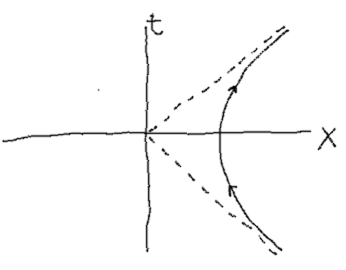


 level!!
 Physics Napkins